Neighborhood · September 13, 2026
Under the Canopy: How Willow Oaks Define Eastover
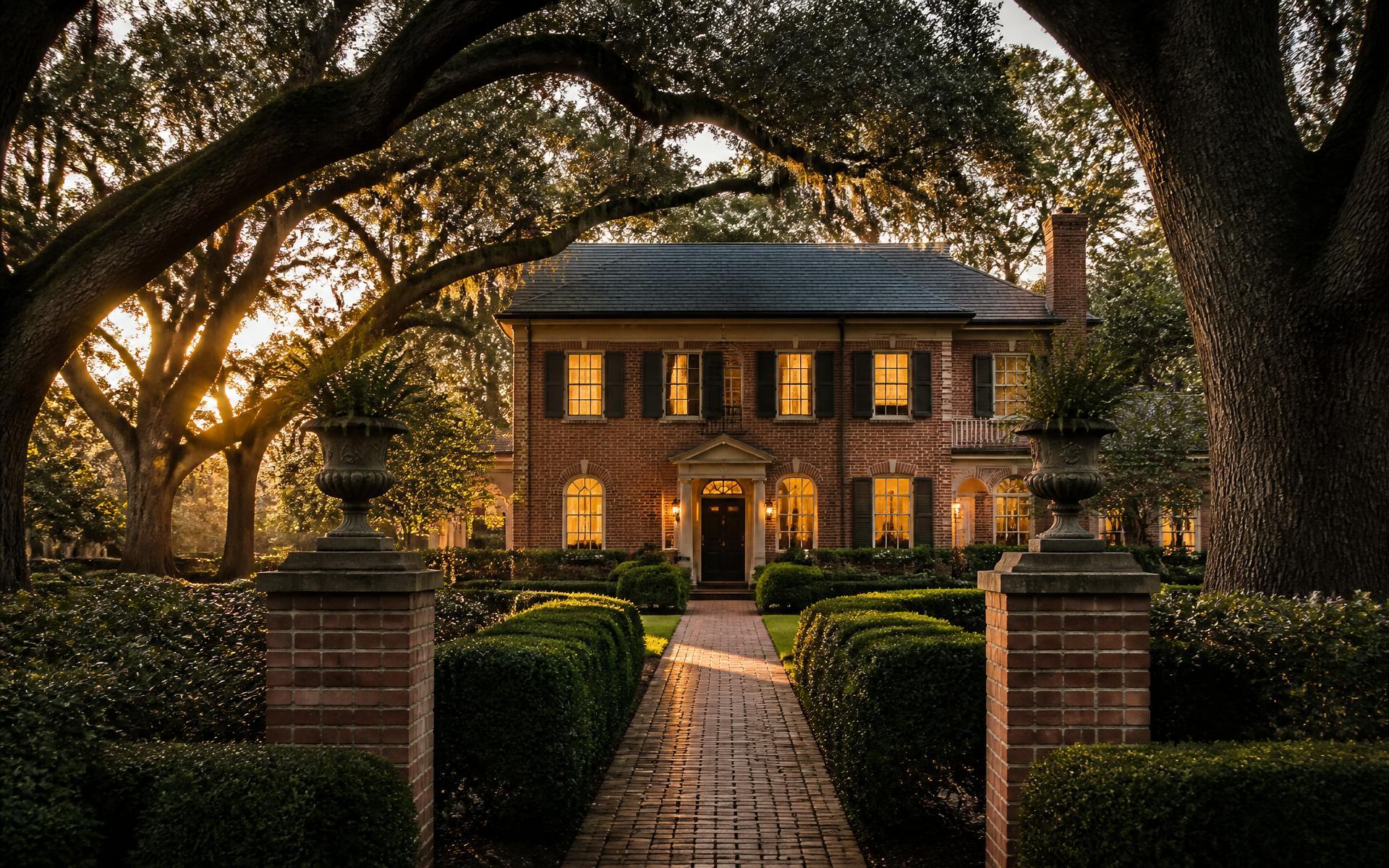
Planted during the late 1920s, Eastover's mature willow oaks do more than frame historic estates. They establish a living architectural ceiling that anchors streetscapes, tempers the local climate, and underpins residential value.
When developer E.C. Griffith laid out the curvilinear avenues of Eastover in 1927, he did not simply subdivide farmland into generous parcels for Charlotte's ascendant civic and industrial leaders. He codified an atmospheric standard. Alongside the wide front setbacks and rolling topographies, municipal landscape plans of the era leaned decisively into a single, majestic species: Quercus phellos, the willow oak. Nearly a century later, those same saplings have grown into an unbroken Gothic vault of interlocking limbs, filtering the fierce summer sun of the Carolina Piedmont into a dappled, luminous green.
In Charlotte, where rapid economic expansion often erases the physical markers of previous eras, the tree canopy serves as an index of permanence. In Eastover, this biological infrastructure does not merely accessorize the built environment; it establishes the spatial order within which its classic architecture resides.
The Willow Oak as Spatial Architecture
Urban planners and landscape historians often speak of "enclosure ratio"—the proportion of street width to the height of flanking vertical planes. In conventional suburban subdivisions, that enclosure is dictated entirely by building facades or garage doors, often resulting in a vast, exposed expanse of asphalt. In Eastover, the willow oaks invert this relationship.
Planted deliberately between the carriage curbs and property lines along premier thoroughfares like Cherokee Road, Colville Road, and Manor Road, the trees have attained heights exceeding eighty feet, with spreads often broader than their stature. Their branches reach across the asphalt to meet their counterparts on the opposite curb. As explored in our survey of Eastover's historic streets, this creates a cathedral-like ceiling that reduces the visual scale of wide roadways and frames the estates behind them.
This canopy acts as a critical mediator of scale. Eastover’s housing stock—predominantly Georgian, Colonial Revival, and Tudor Revival residences constructed between the late 1920s and the 1950s—is substantial. A three-story brick Georgian or a stone Tudor might easily appear imposing or austere if placed in an open clearing. Enclosed beneath the canopy, however, these grand structures feel settled and contextualized. The fine, lanceolate foliage of the willow oak softens the heavy masonry, brick dentils, and slate rooflines, grounding the estate homes in a continuum of living landscape.
The Microclimate of Affluence
Beyond aesthetic balance, the willow oak canopy delivers profound microclimatic benefits that translate directly into livability. During Charlotte’s long, humid summers, unshaded pavement can reach surface temperatures well above 130 degrees Fahrenheit, radiating heat well into the evening hours. Under the continuous foliage of mature willow oaks, ambient street temperatures drop substantially, while shaded building envelopes require significantly less energy to cool.
This thermal buffering creates an immediate, visceral transition when entering the neighborhood. Turning off Providence Road or Randolph Road into Eastover’s interior corridors, drivers and pedestrians immediately experience a palpable drop in temperature, a reduction in traffic glare, and a muted acoustic environment. The heavy leaves absorb street noise, transforming residential front lawns into tranquil private sanctuaries. These physical comforts, established nearly a century ago, are impossible to replicate instantly; they require decades of undisturbed growth, deep root systems, and communal stewardship.
Canopy Preservation and Property Valuation
In residential appraisal practice, the value of mature landscape architecture is difficult to isolate on a line-item basis, yet its influence on aggregate pricing is undeniable. While square footage, interior finish level, and architectural provenance feature prominently in standard underwriting, property buyers consistently assign a substantial premium to established streetscapes. Long-term trends documented in the regional Canopy MLS demonstrate that mature, leafy corridors in ZIP code 28207 command some of the highest price-per-square-foot metrics in the state.
For buyers evaluating Eastover historic homes, the mature trees are synonymous with scarcity. A newly constructed home can be completed in twelve to eighteen months; a century-old willow oak canopy requires eighty to one hundred years to mature. Because real estate values in Eastover are intimately tied to this sense of established permanence, any threat to the tree canopy is inherently a threat to underlying home values.
Prospective purchasers studying county tax records via POLARIS will observe that land value represents an exceptionally high proportion of total assessed value in Eastover. That land valuation is not simply a measure of acreage; it reflects the cumulative prestige of the streetscape, anchored decisively by the overarching oak canopy.
The Realities of Late-Maturity Stewardship
Despite its architectural magnificence, the willow oak canopy faces natural and regulatory vulnerabilities. Quercus phellos is a relatively fast-growing red oak with a typical urban lifespan of 80 to 120 years. Much of Eastover's primary canopy was planted between 1927 and 1940, meaning these iconic specimens are currently entering late maturity or senescence.
Furthermore, Eastover is not a designated local historic district. While neighborhood fabric in some older Charlotte enclaves is governed by the strict review of a historic district commission, Eastover relies primarily on the City of Charlotte’s Unified Development Ordinance (UDO) and municipal tree protections. As original cottages or mid-century homes undergo significant renovation or replacement, the heavy machinery, soil compaction, and utility trenching associated with large-scale modern builds pose a severe hazard to the root zones of mature oaks.
Responsible stewardship within the neighborhood increasingly requires sophisticated arboricultural intervention, including:
- Radial Trenching and Aeration: Relieving soil compaction around root plates caused by decades of pedestrian foot traffic, landscaping equipment, and vehicle parking.
- Crown Thinning and Deadwood Mitigation: Selectively pruning secondary limbs to reduce wind resistance during severe Piedmont summer thunderstorms and winter ice events.
- Canopy Succession Planting: Proactively installing second-generation canopy trees—including willow oaks, white oaks, and American elms—to ensure that as individual century-old specimens decline, an understory is already prepared to take their place.
An Enduring Civic Legacy
On the eastern perimeter of the neighborhood, where the grounds of the Mint Museum Randolph preserve expansive green space, one can observe the canopy at its grandest. Here, the landscape plan integrates seamlessly with public civic life, illustrating what E.C. Griffith grasped intuitively nearly a century ago: architecture alone does not make a landmark neighborhood.
Eastover's identity is suspended between its historic stone foundations and the sweeping branches above them. The willow oaks are not mere adornments to the streetscape; they are its quietest and most enduring structural members, shaping the light, the air, and the enduring value of the neighborhood with each passing season.
Filed under: eastover, streetscape, trees, willow oaks, historic preservation